Call us now: 0141 429 8166
Call us now: 0141 429 8166
Defamation occurs when a false statement is published and has caused (or is likely to cause) serious harm to the person about whom the statement has been made. If you believe you have been the subject of defamation, or if you face a claim, our Specialist Litigation Team can help. Call us on 0141 429 8166 or complete our online contact form.
The law of defamation in Scotland is governed by the Defamation and Malicious Publication (Scotland) Act 2021 (the ‘Act’).
A statement is defamatory if it tends to lower the person’s reputation in the estimation of ordinary persons. Publication includes communicating the statement by any means to others, and where the person about whom the statement has been made has seen or heard it.
Under the Act, defamation proceedings can only be raised as a civil action in the Scottish courts if the published defamatory statement has caused, or is likely to cause, serious harm. In cases where the subject of the defamation is a non-natural person (e.g. a company), for the purposes of the Act, ‘serious harm’ requires there to have been serious financial loss suffered as a result of the defamatory statement.
Where the person who has made the defamatory statement is not domiciled in Scotland, in order to hear the case, the Scottish courts must be satisfied that, of all the places where the statement complained of has been published, Scotland is clearly the most appropriate place to bring proceedings.
The Human Rights Act 1988 (which incorporates the European Convention on Human Rights (‘ECHR’) into domestic law in the UK), is also a relevant consideration when dealing with defamation proceedings. Article 10 of the ECHR protects the right of freedom of expression; Article 8, however, protects the right to a private life, including – in certain circumstances – a reasonable expectation of privacy. Often it falls to the courts to decide where the line between the two is to be drawn and how to properly balance these competing rights.
Indeed, whilst the statement might be considered defamatory, there are a number of defences available under the Act, such as truth, publication on a matter of public interest, and honest opinion. Should any of these defences be successful in court, the person who made the defamatory statement may evade liability to pay damages for the harm caused as a result of publication of the statement.
Defamatory statements can be hugely damaging to the reputation and standing of the party affected, which in turn can lead to significant financial losses. However, careful consideration needs to be given to the potential implications of bringing defamation proceedings, including the risk that the false claims are given further oxygen.
Crucially, defamation proceedings must be brought within one year of publication of the defamatory statement. Scottish courts will not hear defamation cases if they have not been raised within that timeframe.
Livingstone Brown has a wealth of experience in assisting clients on both sides: the subjects of defamatory statements, as well as those accused of making them. Our Specialist Litigation Team was instructed to act for the pursuers in the first defamation case in Scotland to be heard since the introduction of the Defamation and Malicious Publication (Scotland) Act 2021: James Gillespie and Mark MacMillan v Alan Wardrop [2025] CSOH 46. The pursuers were successful in establishing that the statements were untrue and defamatory, but the defender avoided liability by establishing the defence of reasonable publication.
We recognise the need to consider the positives and negatives associated with all options, and to make a clear, informed decision at the earliest stage. We have helped clients seek interdicts against publication and have made arguments around privacy rights. We regularly work alongside media and PR advisers, as well as other legal firms with a related interest. Importantly, we recognise the need for absolute discretion.
If you need specialist advice on your case, call us on 0141 429 8166 or complete our online contact form.
Livingstone Brown is a leading firm of Scottish solicitors. Based in Glasgow, but dealing with cases around the country, the firm has been at the forefront of legal service provision for over thirty years.
If you have a legal problem, getting good quality legal information at the earliest stage can be invaluable. The firm offers a free initial enquiry service; all you have to do is call in, telephone, or e-mail. You won't be charged for your enquiry; we'll let you know by return whether we can help, what we can do, and how much it's likely to cost. We can also offer legal aid where available.
Led by former senior partner Gerard Brown CBE, who continues as a consultant, the firm has built up an enviable reputation for quality of service and client care.
The firm has won various awards over the years. In the 2019 edition of the prestigious Legal 500 rankings Livingstone Brown was ranked as a 'top-tier' firm for general criminal work, and is also recommended for fraud cases. Stuart Munro and Gerard Brown were named as 'Recommended Lawyers'. In the Chambers directory the firm has a Band 1 ranking for criminal work, and Stuart Munro is a ranked financial crime lawyer. The firm was named Criminal Defence Firm of the Year and Family Law Team of the Year at the Scottish Legal Awards 2019.
Reliable, expert advice you can trust. Get in touch today


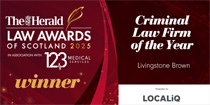


AWARD WINNING, SCOTTISH SOLICITORS